The conservative obsession with birth control and abortion

It didn’t take long, in the very first press conference of the new administration, the subject was broached by the Catholic news network, EWTN on where Joe Biden stands on the Hyde Amendment and the Mexico City Policy, the pro-life policies designed to keep taxpayer dollars from funding abortions either at home or abroad.
The following day, another conservative leaning columnist asked if “the President is going to try to pull back religious conscience exemptions,” citing the case of the Little Sisters of the Poor who object to the requirement of including free birth control in their employee health care plan.

Attempting to place their concerns in the framework of Biden’s call to unify the nation, the question they suggested but did not ask is how can we have unity with intolerance to conservative Christian values?

Let me get this right:

The previous administration grossly mismanaged a pandemic, largely by denying it while worshiping the false gods of ‘free market’ solutions, and simultaneously geared up for an execution spree.  They also fomented insurrection by lying about a free and fair election, but you want to talk about abortion?

Well, I don’t.  With abortion there is no tenable middle ground.  And this is why February 5 does not take a position on abortion.

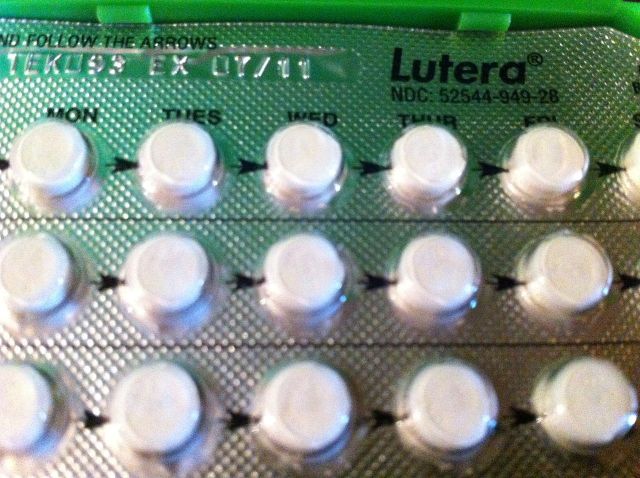
But we do take a stand on birth control.  The best way to reduce abortion is to prevent unwanted pregnancies.  And the surest way to do this, is to ensure women have autonomy over their bodies, and unfettered access to a simple and easy to use method to assert the free will that God gave them.
We also need to jettison, once and for all, the notion that fundamentalist religious beliefs have anything meaningful to offer on the subject of healthy human sexuality.  Abstinence doesn’t work because people don’t actually stop having sex.  Neither does the strict social taboo of conservative religious ideology.  Case in point; Jerry Falwell, Jr.

Heir to his father’s moral majority, Falwell continued to espouse that sex outside of marriage (between a ‘natural-born man’ and a ‘natural-born woman’) was wrong.  Yet he didn’t practice what he preached.  Turns out, he liked to watch the pool boy with his wife.

What consenting adults do in private is none of anyone’s business.  And in normal circumstances, I’d have empathy for Falwell; he’s clearly closeted behind the rhetoric and ridicule of his upbringing.

But the message Falwell preached emboldens some Christians to enforce an adamant rejection of anyone outside that particular norm.  For LGBTQ students at Falwell’s Liberty University it creates a hostile environment for some, and for others an odd sense of acceptance in the midst of denial.

Denying our sexuality has manifold consequences when the repression finally gives way to desire.  The persecuted turn on themselves, and religious leaders fail spectacularly, with little remorse or change.

Falwell is just one man.  The modern Catholic Church, on the other hand, protected pedophiles for decades.  And now, for the sake of unity the argument goes, a group of Nuns should be allowed to limit the healthcare of their employees because they feel deliberately avoiding reproduction is immoral.

The moral high ground so often claimed has been defiled time and again by the very people that are supposed to uphold it.  Never mind that among lay Catholics 89 percent say birth control is either morally acceptable or not a moral issue at all.  It begs the question; why do people who are celibate have such opinions on human sexuality?

It’s because these issues aren’t about morality or unity, they’re about control.

Religion can be a tremendous vehicle for good.  But when beliefs are used to exclude and deny, they cause harm.  This is why we do not allow one’s religious beliefs to control or deny another.

If you want to hang up a shingle and offer services, you cannot decline to serve to gays.  If you want to be a landlord, you cannot refuse to rent to colored people.  And if you want to be an employer, you don’t get to control access to basic health care.

Reading List

Reading List

Thomas Frank

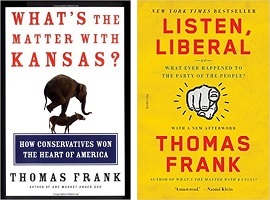
What’s the Matter with Kansas?, 2004
Listen Liberal, 2016
By: Thomas Frank

Social critic Thomas Frank has been taking on status quo politics for quite some time.  He doesn’t mince words and his disdain doesn’t hue along party lines.  Prior to Trump, Frank pointed out a reliance on the ‘professional class’ in both major parties that has led to the disenfranchisement of many from our political process.

In What’s the Matter with Kansas? Frank chronicles the rise of a political conservatism that espouses economic policies that do not benefit the majority of people by waging war over a handful of hot-button cultural issues.

In Listen Liberal, Frank challenges liberals; why has inequality gotten worse under a Democratic president whom is possibly the most liberal of all presidents? Why have the gains of the recovery been monopolized by the top 10 percent?

My challenge, for either conservatives or liberals, is to read both books.  If you’re a liberal, read What’s the Matter with Kansas? first, but don’t get too smug.  Follow through and read Listen Liberal, you might not like what he’s saying, but you should hear it.  Conservatives, do the same.  I bet you’ll be nodding in agreement while reading Listen Liberal.  But will you be able to hear the valid criticisms of conservatism in What’s the Matter with Kansas?


Jane Mayer


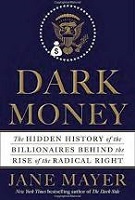
Dark Money, 2016
By Jane Mayer

The short take is that Dark Money has cemented my resolve to be more involved.  Journalist Jane Mayer tracks down the source of funding for many libertarian and conservative think tanks and SuperPACs and the policies and campaigns they advocate for to a handful of billionaires and several hundred rich families.

What is February 5?

February 5 began as one man’s response to yet another mass shooting and his fatigue with the outcry that followed.  From a certain perspective we hear “don’t politicize this tragedy,” while just as predictable an opposing point of view will ask “when is the right time?”

February 5 is a response to this conundrum.  February 5, 2017 is the halfway point between the Orlando night club shooting on June 12, 2016 and the Las Vegas shooting October 1, 2017.  Two of the most deadly shootings in our nation’s history.

So while February 5 is a meaningless date on a calendar, can we talk about gun control on this day?  Would another day be better?  No, the time is always now to talk about important issues.  But also, it matters how we talk about issues and engage others.

February 5 represents a sustained effort for change in our country and in our world by focusing on a few small things that we can agree on that can force the actions in government and the individual to fix the things that are broken.

February 5 is more than one topic or social issue, it is the striving for an ideal, and a metaphor for re-creating a broad middle ground.  The middle is not the exact halfway point between two extremes, but where most people can meet and exist in harmony and balance.

We will identify and support positions that many can agree with regardless of affiliation, and address them without divisiveness and rhetoric.  We need to move away from tribalism and identity politics.  We need to follow through on the promise of America.

Please, join me by supporting this site.

Follow us on Facebook or Twitter.